 Chris Dalton
Executives Finally Admitted AI Dependency and Now They Can't Walk It Back
March 2, 2026
There's a specific kind of trap that happens in meetings. Someone - usually the most senior person in the room - makes a big declarative statement. "We're going to be an AI-first company." Or: "AI is foundational to everything we do now." And everyone around the table nods. And then it goes into the quarterly report. And then into the press release. And then a journalist writes it up. And now it's real. It's on the record. There's no version of next quarter where you walk back into that boardroom and say, actually, never mind.
That's where we are right now. Across the entire executive class, in every major industry, in every market. The commitment has been made. Loudly, specifically, and in writing.
And I think this is one of the most underappreciated business stories of the last two years. Not the AI capabilities themselves. Not the tools. The fact that the people running large organizations have now staked their professional reputations - and in many cases their jobs - on a technology that, by their own admission, hasn't fully paid off yet. And they did it publicly. And now they're locked in.
What the Numbers Actually Say
Here's the part that I keep coming back to. Surveyed CEOs report that only 25% of AI initiatives have delivered expected ROI over the last few years, and only 16% have scaled enterprise-wide. That's from IBM's global CEO study, which surveyed 2,000 CEOs. One in four initiatives actually delivering what was promised. One in six making it to full scale. Those are not great numbers. Those are not numbers you'd put in the headline of your investor day presentation.
And yet. Ninety-four percent of chief executives say they will continue investing in AI at current or higher levels even if the investments do not pay off in the next year. That's from BCG's annual AI Radar report, published just days ago. Ninety-four percent. That is not confidence. That is commitment that has gone past the point of optionality.
Corporate AI investment is growing significantly and will not pull back, with companies planning to double their spending on the technology in 2026, accounting for about 1.7% of revenues. Doubling. Not increasing. Doubling. While a quarter of initiatives are meeting expectations and the majority haven't scaled at all.
I want to be clear about what I think is happening here, because I don't think it's stupidity. I think it's something more interesting and more uncomfortable than that.
This Is What a Lock-In Looks Like
The moment that I think actually matters happened sometime in 2024, when being on an earnings call and not talking about AI became its own kind of risk signal. Despite 374 companies in the S&P 500 mentioning AI in earnings calls - most of which said the technology's implementation in the firm was entirely positive - those positive adoptions aren't being reflected in broader productivity gains. Three hundred and seventy-four companies. Publicly optimistic. Privately struggling.
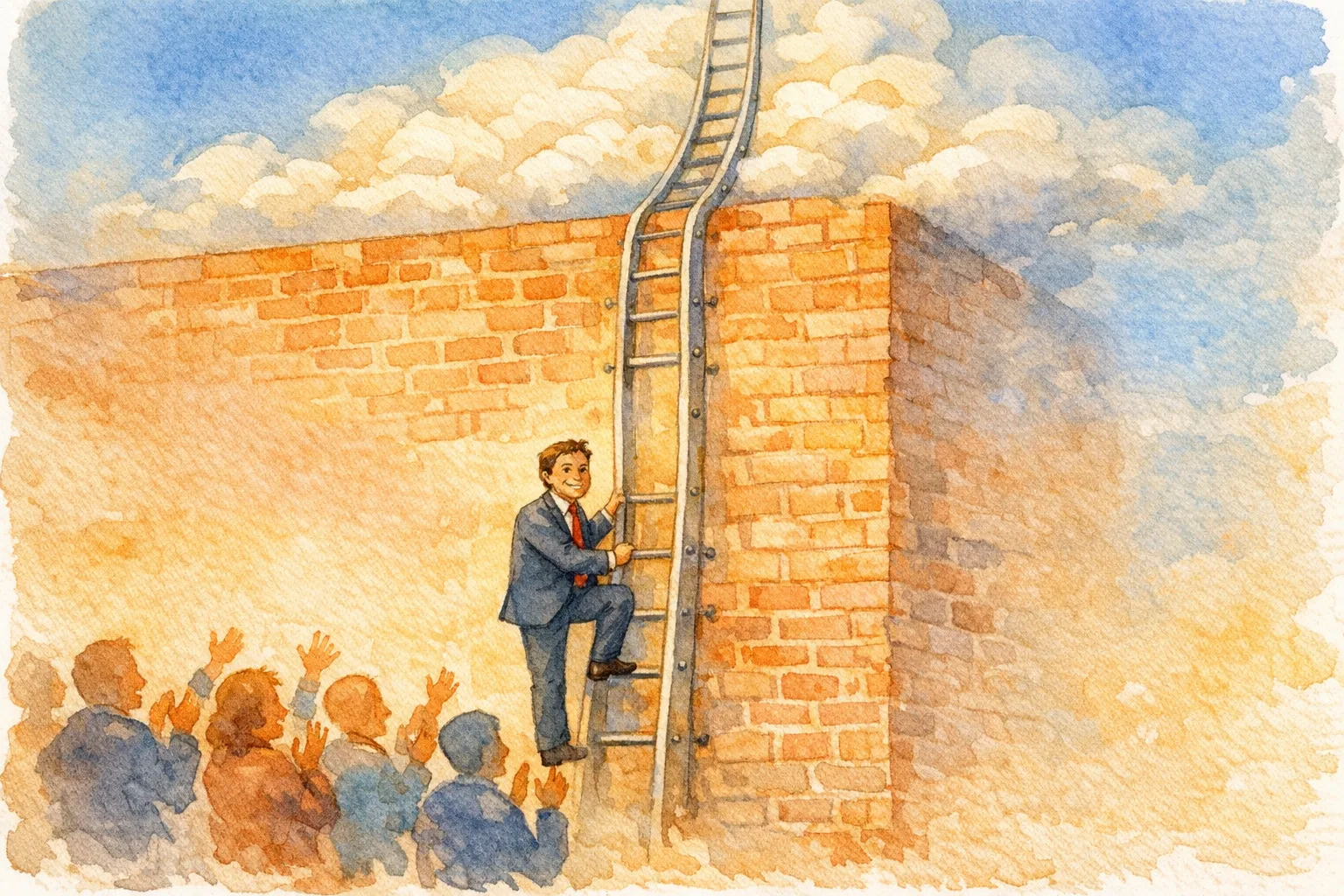
And now there's a much more personal dimension to it. Half of the CEOs surveyed believe their job stability depends on successfully integrating AI in 2026. This pressure is mirrored across the organization: among non-CEOs, more than half believe the CEO or the board should resign if the company loses market share to competitors due to an inadequate AI strategy. So not only are CEOs committed publicly, they're committed in the eyes of their own employees and shareholders. The downside of retreating from AI is now larger than the downside of continuing to invest in something with uncertain returns. That's the trap. That's the lock-in.
Derek said something similar to me once about Star Wars - something about how once you've publicly defended the sequels to enough people, it becomes harder to admit you were wrong than to just keep defending them. I didn't really understand the reference but I think I understand the psychology.
The Gap Nobody Wants to Talk About
The thing that actually concerns me about this situation is not that executives committed to AI. It's the specific shape of the gap they're now managing.
Less than half (45%) of employees - versus 75% of the C-suite - think their company's AI rollout in the last 12 months has been successful. Only 57% of employees say that their company even has an AI strategy - but 89% of the C-suite believes they do. That's a massive perceptual disconnect. The executives believe the strategy exists and is working. The people doing the actual work see something different.
AI adoption in the workplace is deepening divisions and sparking new power struggles between leaders and workers, with half of executives saying that AI is "tearing their company apart," according to new research from Writer, the enterprise AI startup. Half. Half of the executives who publicly committed to AI think it is actively fracturing their organizations right now.
And still the money keeps going in. AI remains a top investment priority, with 69 percent of CEOs planning to allocate 10-20 percent of their budgets to AI over the next 12 months.
I tried to get a rough sense of this dynamic a while back when I was playing with a sales intelligence tool - trying to segment some outreach by company size and see which enterprise accounts were actually running AI projects versus just talking about them. I set up the filters backwards. I was filtering for companies that mentioned AI concerns instead of AI investments and couldn't figure out for a while why my lists kept looking weird. Anyway. The point is that when you're actually inside these organizations, the signal is murky. From the outside, reading the press releases, everything looks decisive.
Why This Is Not Just an Enterprise Problem
If you run a smaller B2B business and you're reading this thinking it doesn't apply to you, I'd push back on that.
Because the executives who are now locked into their AI commitments are your customers, your prospects, your partners, and your competitors. And the psychology of a locked-in buyer is different from the psychology of an exploratory one. 80% of executives say they feel pressure to understand complex AI concepts that historically would not have impacted their role. The same percentage find it difficult to determine which AI investments will have the biggest impact on their business. This is due to factors like AI washing (51%), speed of change (45%), and ambiguity around the best uses for AI (44%).
So you have buyers who are committed to spending on AI, who feel significant pressure around that commitment, who can't easily distinguish real value from AI washing, and who need to show something for it. That's a specific buying psychology. They're not shopping for something to evaluate. They're looking for something that lets them feel like the commitment is paying off - something that makes the investment story coherent.
The sales intelligence tools and lead generation platforms we use to find and qualify these buyers are increasingly trying to surface exactly this kind of intent data - who's actively building versus who's just doing PR. It's worth paying attention to, because the difference matters for how you pitch and what you emphasize. (If you're evaluating that side of your stack, there's a solid breakdown of the landscape over at our best sales intelligence tools piece.)
Stephanie - she doesn't really understand why everyone is so stressed about budgets - asked me last week why the company didn't just "buy the good AI thing" and be done with it. I thought about it for a while. The honest answer is that there's no single good AI thing. There are a lot of expensive commitments with uncertain timelines. But I didn't want to be discouraging so I just said we were looking into it.
The Irrevocability Is the Story
My actual opinion here is that the dependency part of this story is being significantly underreported relative to the investment numbers. Everyone's writing about the dollars. Fewer people are writing about the structural irrevocability of what's happened.
Nearly three-quarters of chief executives (72%) say that they are now the main decision makers on AI, twice the share as last year. AI strategy has moved from the CTO's desk to the CEO's desk. That's not just an organizational chart change. It's a personal ownership change. The CEO is now accountable. Not the tech team. Not the vendor. The CEO.
And once you own it that personally, in that public a way, you don't get to un-own it. AI strategy has officially become the "CEO's mandate" - shifting away from being a strictly technical concern for the chief technology officer. When something is a CEO's mandate and it's in the earnings call and it's in the annual report and your board knows your name is on it - that's not a strategy you revisit lightly next quarter.
The more honest framing of what BCG's data shows isn't that executives are confident. It's that they've gone past the point where retreating is a real option. The question now is what they intend to do: will they pull back AI investments? It's unlikely. No entity, certainly not a public-sector one, will say, "I am not investing in AI." That's not optimism. That's a situation where the off-ramp has disappeared.
I think about this a little bit like holding the elevator. I do it automatically. I'll hold it for someone who's clearly not going to make it in time, and then once I'm holding it I'm committed. I'm not going to let the doors close on someone I've already made eye contact with. But sometimes the person is further away than I thought, and I'm just standing there holding the button, and everyone inside is looking at me, and there's no clean way to stop. You just hold it until the person gets there. That's the AI commitment right now for about 90% of major organizations.
What Happens When the ROI Reckoning Arrives
Here's where I want to be direct, because I've seen a lot of hedged takes on this and I disagree with the hedging.
The reckoning is coming. Not because AI doesn't work - some of it clearly does. But because most CEOs say their companies aren't yet seeing a financial return from investments in AI. Although close to a third (30%) report increased revenue from AI in the last 12 months and a quarter (26%) are seeing lower costs, more than half (56%) say they've realised neither revenue nor cost benefits. More than half. And those numbers are from PwC's global CEO survey, which is not exactly a doom-and-gloom publication.
The companies that are going to come through this well are not the ones who committed loudest or spent most. They're the ones who, underneath the public commitment, were actually building something. BCG's report, The Widening AI Gap, suggests that C-level executives and leadership teams who are deeply engaged with AI are an astounding 12 times more likely to be among the top 5% of companies winning with AI innovation. Deeply engaged is the operative phrase. Not loudly committed. Deeply engaged - meaning they actually understand what they're deploying, where, and why.
We've written about this dynamic before from a few different angles - the Wall Street AI panic that misread the real story, and the quieter confusion that lives inside actual replatforming decisions. The pattern keeps repeating: the public signal and the operational reality are running on completely different timelines.
Tory - he's going through a lot right now, car situation, some other things - told me last week that he's "excited about AI's potential to help him rebuild." I didn't ask what he meant. But I thought about it afterward, and I think that's actually the most honest framing I've heard. Excited. About potential. While the rebuild is still very much in progress and the outcome is not guaranteed. That's exactly where the C-suite is right now.
The One Thing I'd Want Business Owners to Take From This
If you're running a B2B company and you're trying to figure out what this all means for you: the executives you're selling to, partnering with, or competing against have made irrevocable commitments. That changes things.
It means the conversation you're having with them is not "should we do AI" - that ship has sailed, loudly, at a press conference, with a quote in the Financial Times. The conversation is "how do we make this defensible" and "how do we show the board something real." 70% of Fortune 500 executives surveyed say their companies have AI risk committees, 67% report progress on AI infrastructure, and 41% have a dedicated AI governance team. Yet only 14% say they are fully ready for AI deployment. Governance structure is there. Readiness is not. That's a specific kind of anxiety and it shapes every conversation about technology, process, and vendors right now.
Understanding that psychology - the psychology of someone who has publicly committed and privately isn't sure the thing is working - is more useful than any product comparison or feature breakdown. These buyers aren't confused about what AI is. They're worried about whether their specific bet on it is going to look smart in eighteen months.
And honestly? So are they. One of the survey's objectives was to understand how leaders feel about the tension between the imperative to invest and the lack of a guarantee that their AI initiatives will pay off, especially when the median CEO tenure is only about five years. The data overwhelmingly suggests that those who hold the top job understand that AI is fundamentally transforming their industries. While they admit that hype can obscure exactly where to focus, and acknowledge the fear of negative repercussions if initiatives fail, they are not dodging their responsibility.
They're not dodging it. They're just holding the elevator door, waiting for something to arrive that justifies the wait. And they can't let the doors close now. Too many people are watching.