 Chris Dalton
A Self-Driving Startup Got Acquired and Nobody's Talking About What That Means for Fleets
February 28, 2026
A few days ago, electric truck startup Harbinger announced it had acquired Phantom AI, an autonomous driving software company out of Mountain View, California. The deal closed back in November 2025. They just told us about it now.
The coverage it got? Thin. A TechCrunch article, a couple of trade publications, a press release that got buried under the usual flood of AI funding announcements. Nobody seems to be treating it like the inflection point for commercial fleets that I think it actually is.
I want to fix that, because this acquisition is one of the most consequential quiet moves in the commercial vehicle space in years - and if you run a business that depends on a fleet of delivery trucks, box trucks, utility vehicles, or anything in that medium-duty range, you should be paying close attention to what just happened.
What Actually Happened
Electric trucking startup Harbinger acquired autonomous driving software company Phantom AI in an effort to vertically integrate more technology and create new revenue streams. On the same day they announced the acquisition publicly, Harbinger revealed it had already lined up a customer for Phantom's advanced driver assistance tech - German automotive technology giant ZF Group, which agreed to license that technology and plans to sell it to automakers for use in their passenger cars.
Phantom AI was co-founded by former Tesla ADAS engineer Hyunggi Cho and former Hyundai driver-assistance and autonomous-driving engineer Chan Kyu Lee, both of whom bring deep experience in developing and deploying ADAS technologies for major vehicle manufacturers. The Phantom AI team of 30 employees will continue to operate in Mountain View, California.
Harbinger recently raised $160 million in a funding round co-led by FedEx and THOR Industries, both of which are customers. So this isn't a broke startup making a desperate grab. This is a company with real customers, real backing, and a clear strategic direction making its first acquisition while it has momentum.
What Phantom AI actually built: the company developed cost-effective Level 2 autonomous driving solutions focused on reducing everyday driving burdens and improving road safety, emphasizing democratizing safety technologies such as automatic emergency braking and emergency lane support before advancing to higher levels of autonomy.
Practical. Affordable. Focused on what works right now, not what's theoretically possible in 2030. That's the detail everyone keeps glossing over.
The Part That Should Be a Much Bigger Story
Here's what actually matters: Harbinger's CEO said, "Medium-duty [trucking] has a complete lack of safety features. The majority of medium-duty vehicles on the road have no backup cameras, no air conditioning, no lane keeping, no automatic emergency braking."
Read that again. Slowly.
We're in 2026. Your personal car probably parallel parks itself. It definitely has emergency braking. It warns you when you drift out of a lane. And the trucks that are pulling in and out of your neighborhoods delivering packages, navigating tight loading docks, moving through school zones - a significant portion of them have none of that.
As Harbinger's CEO explained, large OEMs have concentrated their ADAS investments on passenger vehicles and heavy-duty trucks, where volumes are significantly higher and the return on engineering spend is clearer. Medium-duty is a smaller segment by comparison, so it hasn't received the same level of attention or investment, and many vehicles on the road today still lack relatively mature safety technologies.
This is a gap that has existed for years, out in the open, and the industry has basically just accepted it. The Phantom AI integration directly responds to fleet customer demand due to the lack of such safety systems in medium-duty vehicles. Which means fleet operators have been asking. Loudly, apparently. And nobody built it until now.
Derek tried explaining to me this week why the new Star Wars movies are actually better than the original trilogy because the technology is better. I nodded. I'm still thinking about it. But I keep coming back to the same feeling I have about fleet safety tech: just because something has been a certain way for a long time doesn't mean it's been acceptable. It just means nobody fixed it yet.
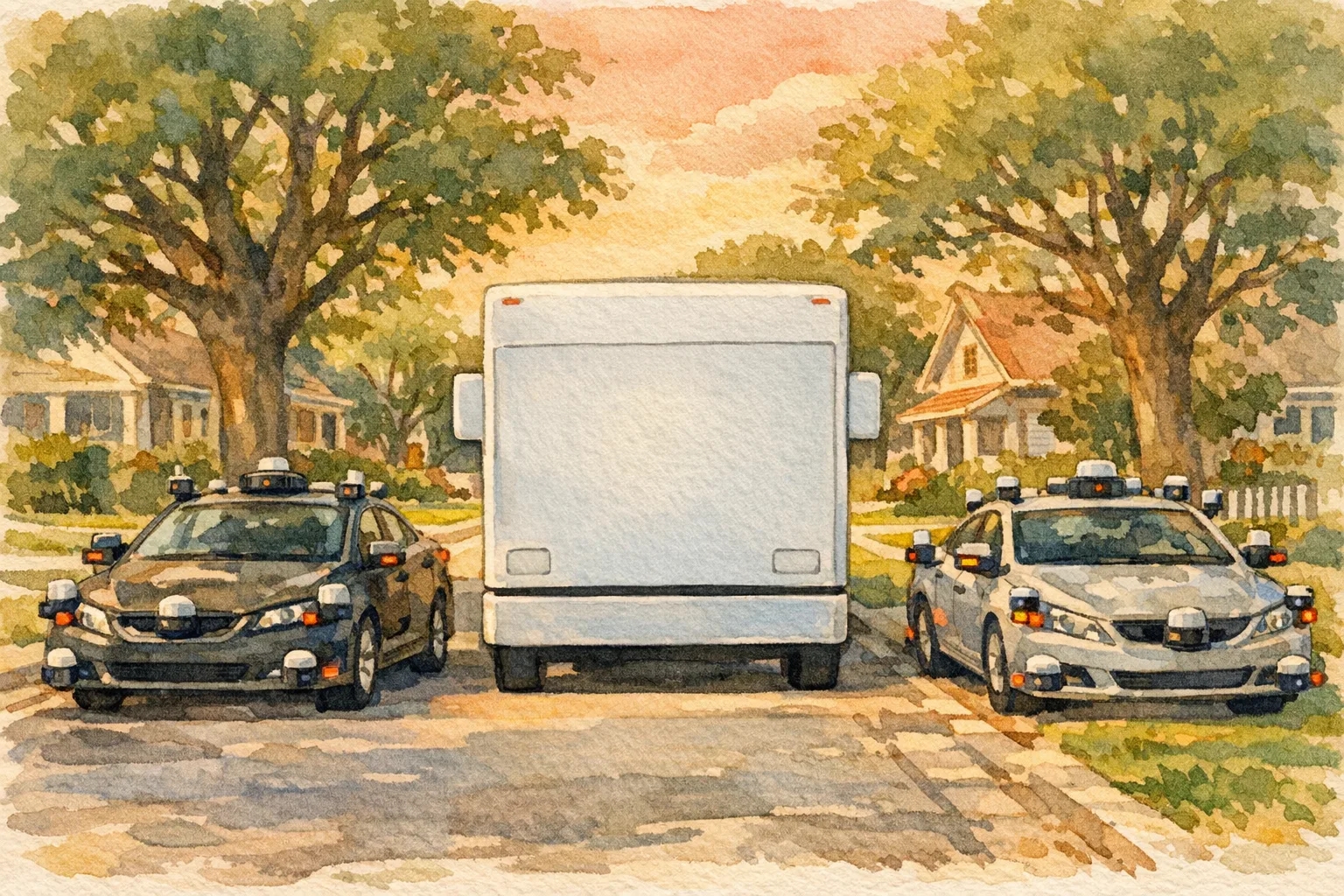
Why This Acquisition Strategy Is Smart (and Most Coverage Missed It)
Most of the coverage framed this as an autonomy story. Harbinger gets self-driving tech. Cool, they'll catch up to Waymo eventually. That's the wrong frame entirely.
This isn't about full autonomy. Phantom AI's technology stack focused on using relatively low-cost sensor configurations - primarily cameras rather than expensive lidar systems - to enable highway and urban driving assistance features. No exotic hardware. No six-figure sensor arrays. Just cameras and software doing what cameras and software can now actually do reliably.
And the ZF licensing deal is the tell. Together, the Phantom AI acquisition and the ZF licensing arrangement position Harbinger to generate a new high-margin software and services revenue stream beyond vehicle manufacturing. They acquired a startup, immediately licensed that startup's core technology to one of the biggest automotive suppliers in the world, and are now getting paid twice - once when a fleet buys a Harbinger truck, and again when ZF sells Phantom AI's vision software to passenger car OEMs.
Harris expects the ZF Group deal will bring in more significant revenue in 2027 or 2028, noting that "the passenger car market is slower, but the volumes are very, very large."
That's a software business layered on top of a truck business. That's the move. Vertical integration allows Harbinger to incorporate these features directly into their platform without layering on third-party supplier margins, making it practical to bring advanced safety capabilities to medium-duty fleets that historically were reserved for higher-volume segments.
I spent a while trying to understand how Harbinger's pricing compares to traditional diesel trucks. Honestly, I got a bit turned around - I was looking at the fleet financing options and ended up in the battery pack division announcements somehow. But the core point is clear: Harbinger has introduced a first-of-its-kind EV platform to market, priced at acquisition parity to traditional diesel vehicles. Same upfront cost as diesel, with electric efficiency and now, autonomy-adjacent safety tech baked in. That's the pitch to fleet operators.
The Market Context Nobody Mentions
This isn't happening in a vacuum. The Commercial Vehicle ADAS Market was estimated at USD 22.84 billion in 2025 and is expected to reach USD 25.74 billion in 2026, growing at a compound annual growth rate of 14.07% to reach USD 57.43 billion by 2032.
That's not a niche. That's a major, accelerating market. And it's being driven by exactly the dynamics that make Harbinger's move timely: the commercial vehicle sector is experiencing an inflection point as fleet operators and OEMs increasingly embrace advanced driver assistance systems, with features historically reserved for premium passenger cars - such as adaptive cruise control, automatic emergency braking, and lane departure warning - now becoming integral to trucks, vans, and buses, underpinned by a convergence of regulatory mandates, technological advancements, and a heightened focus on reducing operational risk.
Regulatory pressure is tightening. Growing concerns over road fatalities involving heavy commercial vehicles have accelerated the adoption of ADAS technologies across the U.S. market, with federal and state authorities promoting stricter safety norms and compelling fleet operators to integrate systems such as collision avoidance, lane departure warnings, and blind-spot detection.
The question for fleet operators isn't whether this technology is coming. It's whether they'll be pushed into it reactively by regulators, or whether they'll get ahead of it and actually benefit from what the technology does. Lower insurance premiums. Better driver retention. Fewer accidents. Real operational savings. Insurance telediagnostics already show that crash-avoidable cases trim claim costs by 30%. That's not a hypothetical. That's money.
Linda mentioned the other day that Gerald replaced the brakes on his truck before they failed rather than after, and she talked about it for fifteen minutes like it was a philosophical breakthrough. I thought about it later, honestly. Because that's exactly the mindset gap here. Some fleet operators will wait for a regulatory mandate or a bad accident before they care. Others will see what's coming and position themselves ahead of it.
What Business Operators Should Actually Take From This
If you operate a business with a medium-duty fleet - delivery, utilities, landscaping, HVAC, food distribution, whatever - you're in the segment that has been actively ignored by the major OEMs for years. Unlike consumer vehicles, where self-driving features are largely a convenience, commercial fleets operate on razor-thin margins where labor costs, fuel expenses, and vehicle downtime directly impact profitability. A medium-duty delivery truck that can operate with advanced driver-assistance features represents a tangible financial return on investment for fleet operators.
That calculation is now changing. The technology is catching up to your segment. For fleet customers, the integration of advanced driver assistance systems promises tangible safety benefits, including automated emergency braking and lane-keeping assistance - features that not only address regulatory and insurance pressures but also speak to operator demand for technologies that can reduce accident rates and improve driver comfort and retention.
Driver retention. That one gets overlooked constantly. The trucking industry has faced a persistent driver shortage that reached an estimated deficit of roughly 80,000 drivers in recent years, a figure that has fluctuated but remained structurally elevated. ADAS technology that reduces driver fatigue, improves safety, and eventually enables more autonomous operation could help alleviate some of that pressure.
You can't hire drivers you can't find. You can stretch the ones you have by making the job less physically and mentally exhausting. Adaptive cruise control and lane keeping aren't glamorous. But they're the difference between a driver who feels supported and one who burns out and quits in six months. If you run a business and you're worried about turnover - and everyone is worried about turnover right now - that's a concrete lever you haven't fully accounted for.
We talk a lot on this site about how software choices compound over time, how stress-testing your operational stack reveals risks you didn't know you had. Fleet technology is the same. The business that's still running trucks with no emergency braking in three years isn't just behind - it's exposed. Liability-exposed, insurance-exposed, regulation-exposed.
The Broader Pattern Worth Watching
Harbinger-Phantom isn't the only move in this space. Back in 2024, Canada-based Element Fleet Management acquired fleet optimization software startup Autofleet for $110 million. Pronto.ai, which developed a self-driving system designed for haulage trucks and other off-road vehicles used at construction and mining sites, acquired competitor SafeAI. The consolidation is happening. The players who want to own this space are acquiring the pieces they need right now, while valuations are still manageable and the technology is proven enough to deploy.
What we're watching is the middle layer of autonomy getting built out. Not Waymo-level full self-driving. Not the science fiction version. Just the safety and assistance technology that makes the vehicles less dangerous and the drivers less exhausted. Features historically reserved for premium passenger cars are now becoming integral to trucks, vans, and buses. That's the story. That's what's actually happening.
Tory gave a little talk in the break room last week about how the best time to prepare for a change is before the change is forced on you. His car got repossessed two weeks ago so I try not to take his life advice too literally. But on fleet technology? He's accidentally right.
The Harbinger-Phantom AI deal is a signal. It tells you where the investment is going, who's buying what, and which segment of the market is finally getting the attention it needed. Harbinger's strategic timing may capitalise on fleets' growing willingness to adopt software-enabled solutions as part of broader electrification and digitalisation strategies.
Fleet operators who read that acquisition announcement and thought "hm, interesting" and moved on are going to be surprised in two years when their insurance carrier starts asking questions about ADAS adoption, or when a regulatory mandate lands and they're scrambling. The ones who read it and started conversations with their vehicle procurement teams are going to be ahead.
This acquisition was quiet. The implications aren't.
Chris writes about B2B tools and business trends for B2B Jack. He holds elevators and thinks about things longer than is probably necessary.