 Tory Evans
Wall Street Killed Software Stocks Then Rescued Them in the Same Week
February 27, 2026
I want to tell you about the most dramatic week in software markets in recent memory, because I think people are completely misreading what it means. Not the analysts. Not the traders. Especially not the business owners watching their software vendors sweat.
Here is what happened, in order. A Substack post went viral over a weekend in late February 2026. Citrini Research published a 7,000-word hypothetical scenario dated June 2028 that painted a scary portrait of AI disrupting white-collar jobs and sparking financial contagion. It was written as fiction - a dispatch from the future, a thought experiment. Citrini explicitly disclaimed the memo as "a scenario, not a prediction," and the post closed with a reminder that readers are still in February 2026, not June 2028: "The S&P is near all-time highs. The negative feedback loops have not begun."
Didn't matter. By Monday morning, Wall Street had decided the fiction was reality.
All three major indexes fell Monday, led by a more than 800 point drop in the Dow Jones Industrial Average. Software firms Datadog, CrowdStrike, and Zscaler each plunged more than 9%. IBM fell 13%, its worst one-day performance since 2000. American Express, KKR, and Blackstone - all called out by Citrini - also tumbled. A fictional scenario written by a finance Substack writer moved the stock market like it was breaking news from the Fed.
Then, three days later, software stocks made a comeback after Anthropic hosted its enterprise agents event, where it revealed new partnerships, quelling some investor fears that the sector could be displaced by artificial intelligence. The AI startup launched new updates to Claude Cowork that allow companies to integrate the productivity tool into a host of enterprise apps, such as Salesforce-owned Slack, DocuSign, LegalZoom, FactSet and Google's Gmail.
Salesforce shares jumped 4% following the Anthropic announcement while Docusign and LegalZoom each gained more than 2%. Thomson Reuters' stock surged more than 11% and FactSet shares rose nearly 6%. IBM, which had just posted its worst single day since 2000, bounced back the next morning.
Same company. Same AI. Three days apart. Once the villain, once the savior.
This Was Not a Normal Market Event
Let me be direct about my read here: what happened this week was not a rational market processing new information. It was a market having a panic attack, calming down, and then pretending it had been thoughtful the whole time.
The Citrini post was labeled as speculative fiction - titled "The 2028 Global Intelligence Crisis," the viral essay paints a catastrophic picture of an economy destroyed by artificial intelligence, describing a world in which the S&P 500 has plummeted 38%, unemployment has spiked to 10.2%, and the U.S. economy is trapped in a deflationary spiral caused by the mass displacement of white-collar workers. It's vivid. It's provocative. It is explicitly not a forecast.
And yet, IBM just fell when Anthropic revealed that its AI models can handle COBOL, and a bunch of cybersecurity stocks fell a few days ago when Anthropic's models found a bunch of security flaws. But those were real announcements of model capabilities; Citrini's post was just a scenario for how some current business models could be disrupted.
That distinction should matter. It apparently didn't. Did none of the analysts tasked with keeping tabs on Visa and Mastercard stock really think about the possibility of AI disruption until a blogger sketched out a sci-fi future mentioning those companies by name? This smells more like a wave of sentiment - basically, a bunch of traders read the post, got spooked, and coordinated their panic-selling on the stocks that the post mentioned.
I spent part of Tuesday morning reading that Citrini piece from the parking garage where I used to park my car. The wifi still reaches down there. Old habits. My point is, I had time to actually read the whole thing - and even I, a man whose personal financial situation is, let's say, actively humbling, could tell the difference between a doomsday scenario and a balance sheet. The market apparently could not.
The Actual Numbers Were Already Terrible Before the Panic
Here's what makes the dramatic week even more interesting: the selloff didn't start with Citrini. The software sector had been bleeding for months. Software stocks officially entered a bear market last week. The iShares Expanded Tech-Software Sector ETF is now 27% from its September 2025 peak. Companies in the sector within the S&P 500 are down roughly 18% over the last six months, while the index itself is up 9% over that time frame.
Oracle, Varonis, CommVault, and Circle make up the group of the worst-performing stocks in the sector. All four stocks are down more than 50% from their September highs. That's not a correction. That's structural doubt.
The actual underlying fear - the one that was already in the room before Citrini lit it up - is a real business model problem. The real threat isn't AI replacing software overnight - it's AI reducing the headcount that uses software. As SaaStr's Jason Lemkin explained, if 10 AI agents can do the work of 100 sales reps, you don't need 100 Salesforce seats anymore - you need 10. That's a 90% reduction in seat revenue for the same work output.
That is an actual structural concern. Not a 2028 scenario. Something happening now, at renewal cycles, in procurement conversations. Fiscal years mostly line up with calendar years, so 2026 enterprise spend had been set in Q4 2025, when "agentic AI" was still a buzzword. The mid-year review was the first time procurement teams were making decisions with visibility into what these systems could actually do. Some watched their own internal teams spin up prototypes replicating six-figure SaaS contracts in weeks.
Procurement leverage is shifting. That part of the thesis is real.
But Then the Rescue Arrived From the Same Direction as the Attack
Here is the genuinely interesting part. The thing that scared markets was Anthropic - specifically, Claude Cowork, a tool designed to automate knowledge work and eat into software vendor revenue. Thomson Reuters plunged 15.83% Tuesday, its biggest single-day drop on record; and LegalZoom sank 19.68%. All of it triggered by fear of what Anthropic's tools would do to existing software businesses.
And then, days later, Anthropic announced it was partnering with Thomson Reuters. And LegalZoom. And Salesforce, DocuSign, FactSet, Gmail. "We believe the notion that Anthropic is looking to enhance the capabilities of most software tools rather than disrupt came as a positive for our names," a team at Piper Sandler wrote in a note to clients. Anthropic positioned the Claude product as an "orchestration layer" for businesses rather than a replacement for other tools.
So Anthropic terrified software companies, then announced it was going into business with them. The stocks that crashed bounced. The story went from apocalypse to partnership in under a week.
Chris came over to my desk when that bounce happened Tuesday afternoon and said, genuinely confused, "wait, didn't they just tank all these stocks?" And I told him yes, and he blinked and walked away. Chris is extraordinarily good at blinking and walking away from things that don't make sense. I admire that quality. I have not mastered it.
What Wall Street Is Actually Pricing In
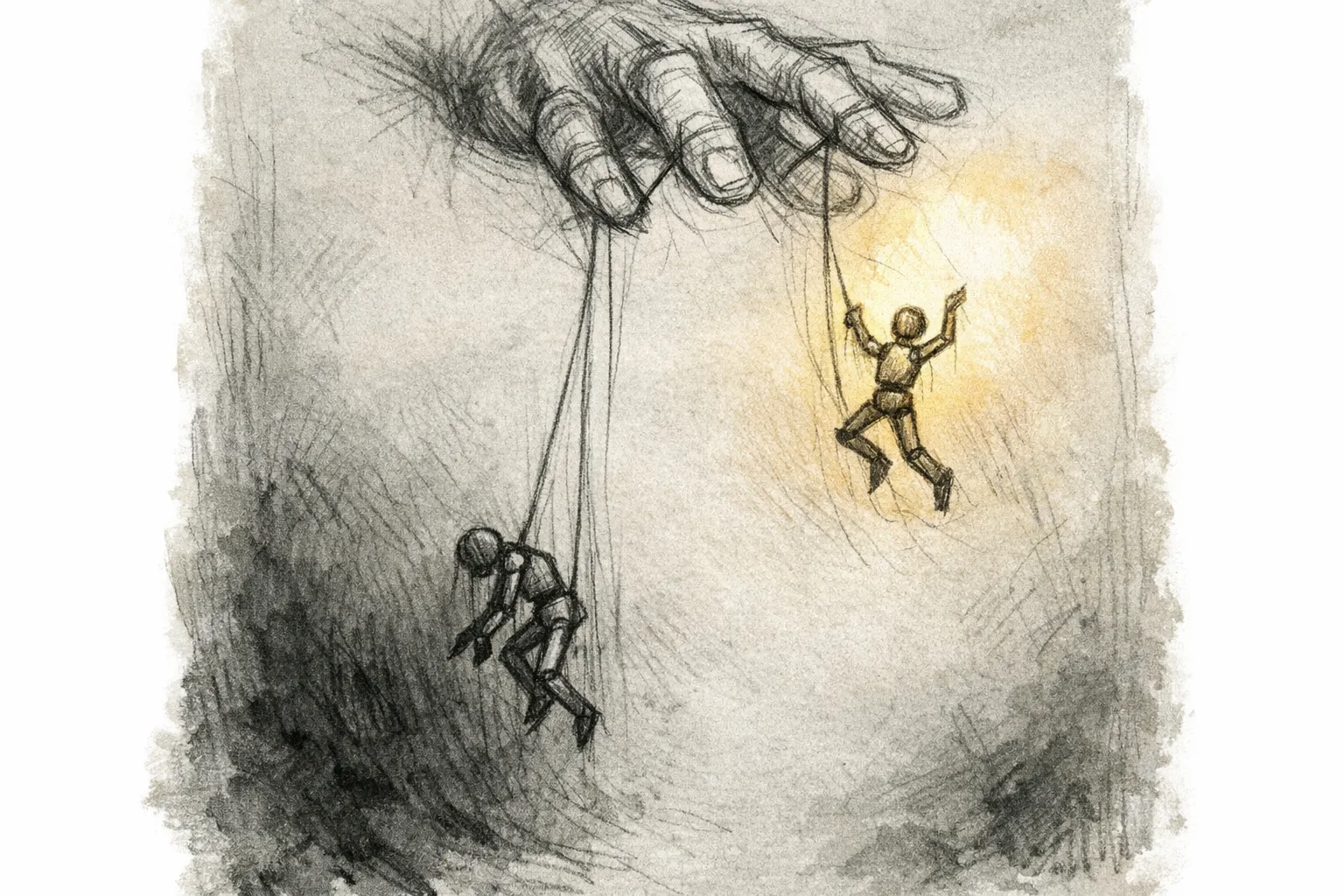
Here is my read, and I'm committing to it: the market is not processing a coherent thesis about AI and software. It is processing fear. Wall Street has gone from bearish to doomsday lately, with traders dumping shares across the industry as fears about the destruction to be wrought by artificial intelligence pile up. "We call it the 'SaaSpocalypse,' an apocalypse for software-as-a-service stocks," said Jeffrey Favuzza at Jefferies. "Trading is very much 'get me out' style selling."
"Get me out" style selling is not analysis. It's a panic. And the problem with panic-driven selloffs in software is that they don't discriminate. JPMorgan analysts said the sell-off had been "indiscriminate" and that a worst-case scenario remained unlikely: "this perceived risk of disruption has driven sell-off in both Quality and Speculative Growth Software names indiscriminately." Companies that are genuinely exposed to AI disruption are being sold alongside companies that will benefit from it. That's not markets being smart. That's markets being scared.
And Citadel, for what it's worth, went further than JPMorgan. Citadel looked at actual labor market data. While Citrini's essay insists that software and consulting jobs are currently collapsing, Citadel points to Indeed job posting data showing that demand for software engineers is actually rising rapidly, up 11% year over year in early 2026. The doomsday scenario's empirical foundation is shaky, at best.
Derek told me he'd been reading about the selloff and thought it sounded like when the Death Star blew up Alderaan. I told him I didn't understand the reference. He looked at me the way he always does when I don't understand a Star Wars reference, which is like I've told him I've never heard of breathing. But the point stands: markets sometimes destroy things on the basis of incomplete data, and the question is always whether the real thing was actually as valuable as people thought.
What This Means If You Run a Business
I'm not writing this as a stock tip. I'm writing this because what happened this week has a direct translation for anyone running a company that buys or builds software - which is, basically, everyone reading B2B Jack.
The Citrini scenario that moved markets isn't pure fiction. The seat compression argument - fewer humans using fewer SaaS seats - is a real pricing pressure that smart procurement teams are already exploiting. Futurum analyst David Nicholson argued that the companies aren't so easily replaced, pointing out that stringent requirements for data governance, security, and compliance in enterprise software make it far more challenging for new entrants than the market often realizes. "We're underestimating how risk-averse a real business is going to be to making wholesale changes and depending upon AI," he said.
That's the thing that gets missed in both the panic and the relief rally. The actual transition is messy and slow in practice, even if it looks fast on a capability chart. In practice, enterprises are still running Informatica jobs from 2014, and those jobs will outlive us all. The gap between "AI can replace this" and "this Fortune 500 has actually replaced it" turns out to be filled with procurement processes, SOC 2 audits, change management committees.
The software that should actually be scared right now is the kind whose entire job is letting humans move data around manually - writing emails, reformatting text, stitching together reports that two people touch and nobody reads. That's the blast zone. A Salesforce instance with ten years of customer history and custom objects built by someone who no longer works there is not in the same conversation as a $400-a-month tool that summarizes PDFs.
Linda asked me last Thursday if she should be worried about all the software news. She said Gerald had seen something on TV about AI taking over companies. I told her the companies with real structural value are fine, and the companies that were overpriced wrappers around simple workflows were probably overdue for a correction. She nodded and said Gerald had also been saying they needed to repaint the kitchen. Linda has a very grounding presence.
The wait-and-see posture is rational for buyers right now. Procurement teams are running renewals with one eye on what their internal team could spin up in six weeks, and that leverage is only going to grow. That's going to compress software revenue for the next several quarters regardless of what the stock market does. That's the real story underneath the dramatic swings.
The same week the AI integration conversation is happening at the stock market level, it's also happening inside every mid-size company's software budget review. We've been writing about this kind of tension for a while - the confusion that follows any major AI replatforming decision isn't a bug, it's the current state. That confusion is well documented and it's not going away soon.
The Thing About Narratives Moving Markets
I want to come back to the Citrini post one more time, because I think the most honest observation about this week isn't about software valuations. It's about the power of a story.
A 7,000-word fictional scenario, labeled as such, moved hundreds of billions of dollars in market cap in 72 hours. That is the actual news event here. Not the doomsday scenario. Not the rescue rally. The fact that a well-told story about the future can materially damage real companies in the present - companies with real employees, real customers, and real earnings that mostly beat expectations.
Mona Mahajan at Edward Jones noted that investors have been quickly pulling money out of sectors viewed as vulnerable to AI disruption. She noted that despite the sharp moves in stock prices, the underlying businesses themselves haven't materially changed, underscoring how much of the reaction remains speculative.
The businesses didn't change. The story changed. And then the story changed again, and the businesses bounced. That is what happened.
I find this useful information as someone who coaches people through transitions. The narrative that surrounds a situation often moves faster than the situation itself. That's true in markets. It's true in companies. It's true in personal lives, not that I have any strong opinions about that.
My Actual Take
Here it is: the software sector is in a genuine repricing, but this specific week was a case study in market irrationality, not market intelligence. The selloff went too far. The recovery was partly earned and partly just relief from a panic breaking. JPMorgan sees potential for a software rebound based on the "overly bearish outlook on AI disruption and solid fundamentals." Goldman Sachs said the selloff was too broad. Even Wedbush - which tracks this stuff closely - said in a research note that Anthropic's event showed the competition risk to software from AI is "overblown," arguing that models aren't capable of replacing entire workflows that remain "deeply embedded" in software infrastructure.
But I don't want to just point at irrational behavior and call it done. The underlying concern - that AI will eat into per-seat pricing, that procurement leverage is shifting, that some software categories will compress structurally over the next three to five years - is real. It's just not the S&P-38%-unemployment-10.2% apocalypse scenario that wiped out a trillion dollars in market cap over a long weekend.
The companies to worry about are the ones that haven't figured out how to position AI as complementary rather than competitive to their core revenue model. The ones that announced partnerships with Anthropic this week - even if the partnership itself is early - are sending the right signal: we're infrastructure, not friction. We're where AI lives, not what AI replaces.
The companies that are just hoping the panic subsides and the pricing pressure doesn't materialize? Those are the ones that should actually be scared. Not because of a Substack post. Because the procurement managers are getting smarter, and the AI tools that make it easier to threaten to cancel a SaaS contract are only going to improve.
Anyway. I sent my 6am motivational text to my coaching group from down in the parking garage this morning. The wifi still reaches from Level 2. Small wins. Growth is sometimes just knowing where the signal is strongest and working from there.