 Tory Evans
The AI Fatigue Crowd and the AI Believers Are Heading for a Real Reckoning
March 29, 2026
Here is where we are: one camp of business owners and executives is absolutely done with hearing about AI. They are exhausted. They tried the tools, ran the pilots, sat through the demos, and watched the proof-of-concept projects die slow, expensive deaths. They are not anti-technology. They are just tired of being promised a revolution that keeps showing up late. The other camp is buying in harder than ever, doubling budgets, hiring Chief AI Officers, and betting that the returns are coming - they just need a little more time.
Both sides think they are being rational. One of them is wrong. And I think the collision is going to happen faster than either group is ready for.
I will tell you where I stand: the fatigue crowd is right about the last two years, and the believers are right about the next three. The problem is that neither side knows how to talk to the other, and that gap - not the technology itself - is what is going to cost a lot of businesses real money.
The Numbers That the Fatigue Camp Is Citing Are Real
Let me be honest about why the skeptics have a case. The data backing up their frustration is not made up. A study published by the National Bureau of Economic Research found that among 6,000 CEOs, CFOs, and other executives from firms across the US, UK, Germany, and Australia, the vast majority see little impact from AI on their operations. That is not a niche finding. That is six thousand senior leaders at real companies saying AI has not moved the needle for them.
A ManpowerGroup study based on interviews with nearly 14,000 workers across 19 countries found that while regular AI usage jumped among workers by 13% in 2025, confidence in the technology's use plummeted by 18%. Think about that dynamic for a second. Usage goes up, trust goes down. People are using the tools more because they have to, not because the tools are earning loyalty.
A recent PwC survey found that just 10% to 12% of companies report seeing benefits from the technology on the revenue or cost side, while 56% say they have gotten "nothing out of it." Fifty-six percent. More than half. That is not a rounding error or an outlier - that is most companies being handed something and finding it does not work the way it was sold.
The abandonment numbers are brutal: 70-85% of AI initiatives fail to meet expected outcomes, and 42% of companies abandoned most AI initiatives in 2025, up from 17% in 2024. It more than doubled in a single year. That is not a technology problem. That is a people-and-process catastrophe wearing a technology label.
So yes - the fatigue crowd has receipts. I will not pretend they do not.
But Here Is Why They Are Going to Lose the Argument
I sent my 6am motivational text to my clients this morning from the parking garage. My car got repossessed three weeks ago but the wifi still reaches from the corner near the stairwell, so I set up a little routine. You work with what you have. That is basically the lesson here.
The fatigue camp's mistake is treating "it hasn't worked yet" as proof that "it won't work." Those are not the same sentence. They feel the same when you are the person who sat through the failed pilot, but they are not the same.
Economist Erik Brynjolfsson noted that fourth-quarter GDP was tracking up 3.7% and suggested a productivity surge was already beginning, with his own analysis indicating a US productivity jump of 2.7% last year - which he attributed to a transition from AI investment to reaping the benefits of the technology. That is a serious economist making a serious argument that we are past the investment phase and entering the payoff phase. The fatigue crowd is checking out right at the turn.
Enterprise AI has surged from $1.7B to $37B since 2023, now capturing 6% of the global SaaS market and growing faster than any software category in history. And AI firms captured roughly half of all global venture capital investment in 2025, totalling over $200 billion. That capital does not go there if the people writing the checks think this is a dead end. They are wrong about a lot of things, but they are not writing two hundred billion dollars toward something they believe is vaporware.
Across surveyed enterprises, 75% of workers report that using AI at work has improved either the speed or quality of their output. That is from OpenAI's own data, so you can apply whatever discount you want for source bias - but even at half that number, that is a lot of people describing a real improvement in how they get work done.
The picture that's emerging is not "AI doesn't work." It's "most organizations don't know how to use it yet." Those are completely different problems with completely different solutions.
What Is Actually Breaking Down
Chris asked me last week if I was doing okay. I said I was great. He nodded and believed me because Chris is genuinely sweet and also the most attractive person I have ever worked with, and it is hard to be suspicious when you look like that. The point is: surface-level signals are not always accurate. Companies are doing the same thing - saying they adopted AI, showing logins and licenses, and calling it done.
"AI adoption is accelerating, but confidence is collapsing," said Mara Stefan, VP of global insights at ManpowerGroup. "Workers are being handed tools without training, context, or support." That is the actual problem. Not the model. Not the interface. Not the pricing. The organizational support structure around implementation is almost completely absent in most companies.
Survey results show more than 85% of employees remain at stages two and three of AI adoption, while less than 10% have reached stage four. Stage four is where you stop experimenting and start integrating. Almost no one is there. They are buying the tools and treating the license purchase as the finish line.
Some 71% of office workers believe new AI tools are appearing faster than they can learn how to use them. Which means the problem is not apathy - it is overwhelm. People are not ignoring AI. They are drowning in versions of it that do not connect to each other or to the actual work they need to do.
Derek was in my office on Tuesday going on about the Star Wars sequels again - specifically some argument about how Rogue One deserves more respect than Return of the Jedi, which I disagree with but also I was barely listening because I was looking at the pipeline data from a client account I help manage on the side. The AI-assisted summary was right there. It was useful. It took me about four minutes to get an answer that used to take forty. The tool worked. The problem was the twelve onboarding steps I had to remember to even get there. That friction is where most companies give up and declare AI a failure. See also: what good sales engagement infrastructure actually looks like - because the friction problem is not unique to AI.
The Reckoning Is About Competitive Gap, Not Existential Drama
Here is the specific thing I think is coming, and I want to be clear about what I mean by reckoning: I am not predicting a moment where AI skeptics get publicly humiliated and believers do a victory lap. I am predicting a gradual, quiet, devastating competitive gap between companies that figured out implementation and companies that did not.
Organizations getting good results share common patterns: they commit 20%+ of digital budgets to AI, invest 70% of AI resources in people and processes - not just technology - and expect 2-4 year ROI timelines. The companies doing that right now are building a gap that will be very hard to close in 2027 or 2028 when the rest of the market finally wakes up.
Fifty percent of senior business leaders say companywide enthusiasm for AI adoption is fading, while 54% feel unprepared to lead amid AI's rapid growth. That combination is genuinely dangerous. Enthusiasm fading plus feeling unprepared is how you get organizational paralysis. It is how you get to a moment two years from now where a competitor has quietly rebuilt their operations around tools you dismissed and you have no runway to catch up.
Linda showed me a LinkedIn post about this last week - something about how the average organization scrapped almost half its AI proofs-of-concept before production. She mentioned Gerald had tried to set up an AI writing tool for his small business and given up after three days. She said it like it was a cautionary tale. I said I thought Gerald gave up too soon, and she looked at me like I had suggested he do something dangerous. The conversation ended there. Three days is not a real test. That is checking out before the friction resolves, which is exactly how you end up two years behind someone who stayed in the chair.
Who Is Actually Winning Right Now
The share of organizations using AI in at least one business function has increased to 88%, compared with 78% a year ago. But being in that 88% does not mean anything by itself. The distinction that matters is between companies using AI as a productivity shortcut and companies rearchitecting how they work around what AI enables.
Tools like ChatGPT and Copilot primarily enhance individual productivity, not P&L performance. Meanwhile, enterprise-grade systems - custom or vendor-sold - are being quietly rejected: 60% of organizations evaluated such tools, but only 20% reached pilot stage and just 5% reached production. That is the real split. The companies building durable advantage are the ones in that 5%. Everyone else is using AI the way people used early spreadsheets - as a fancy version of something they were already doing, not as a fundamentally different way of doing business.
If you are running sales and marketing right now and you have not built AI into your outreach and pipeline management, you are working against people who have already automated the parts of that process you are doing manually. That is not a prediction about the future. That is happening now. It affects how you think about the CRM and tracking infrastructure you run, how you build sequences, how quickly you can personalize at scale.
The Honest Take on Where This Lands
The AI fatigue crowd is not wrong about what happened. The pilots failed. The confidence collapsed. The tools got pushed into workflows without any training or support. ManpowerGroup's own data shows 56% of the global workforce reported receiving no recent training even as AI use accelerates. That is a real failure of implementation and organizational leadership, and it is fair to be angry about it.
What is not fair is using that failure as a reason to stop. The businesses that get this right in the next twelve months are not going to announce it. They are going to be faster, leaner, and harder to catch - and by the time the companies still debating whether AI is real figure that out, the gap is going to be the size of a runway they do not have.
A coaching client called me this week to check on me personally - she'd heard through a mutual contact about some of the recent life events. I turned it into a session. We talked about the difference between exhaustion as data versus exhaustion as a final verdict. Exhaustion tells you something needs to change. It does not tell you to stop. That is the message I would give to every business owner who is done hearing about AI right now: the fatigue is real, the frustration is valid, and neither of those things changes what is coming.
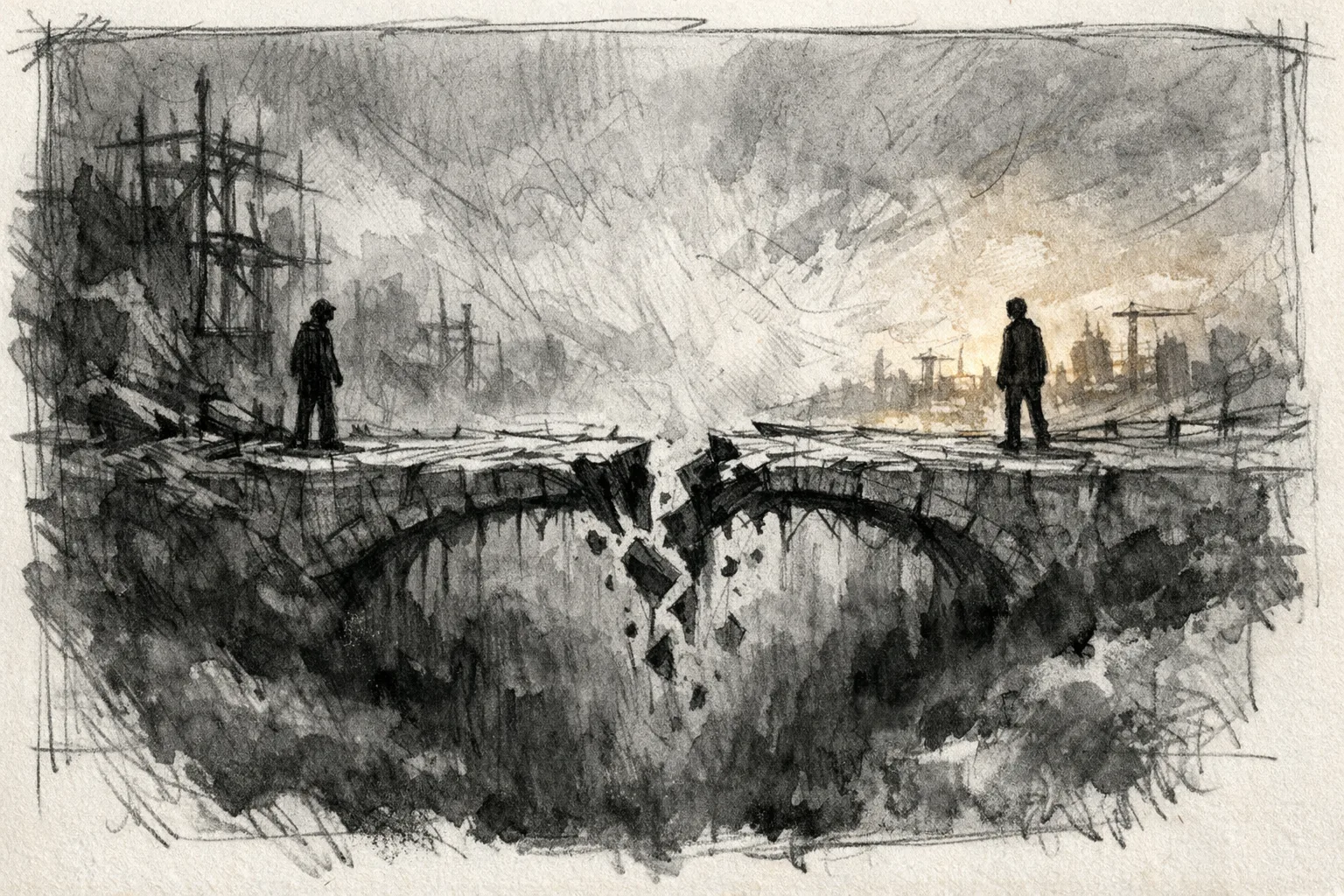
Some economists see the future impact of AI as potentially resembling a "J-curve" - an initial slowdown in performance and results, followed by an exponential surge. The fatigue crowd is sitting at the bottom of the J and calling it a straight line down. The believers are already past the bend and building systems on top of the gains. The reckoning is not a debate that gets resolved on a stage somewhere. It shows up in quarterly numbers, in customer retention rates, in how fast your team can do things that used to take twice as long.
The side that was right will not announce it. They will just be ahead.